
Beyond the Billboard: Emerging Technologies Rewriting Advertising’s DNA | Adgrid Media
 by
by 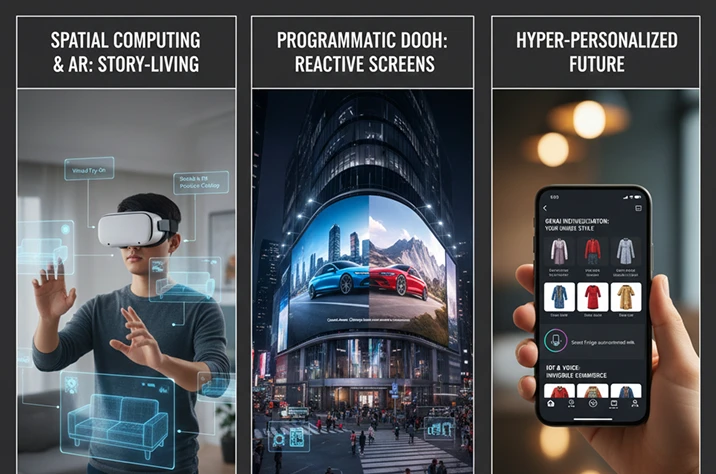
For decades, the fundamental model of advertising remained static: interrupt the content consumers want to see with the content brands want to show them. Whether it was a TV commercial break or a pop-up banner, the relationship was largely adversarial.
However, we are currently standing on the precipice of a revolution. New technologies are not merely digitizing old formats; they are dismantling the concept of “interruption” entirely. The future of advertising is immersive, predictive, and hyper-personalized.
Here are the four key technologies that are changing advertising forever.
1. Generative AI: From Segmentation to Individualization
Historically, advertisers relied on “segments”—grouping people by age, location, or broad interests. Generative AI (GenAI) is killing the segment and birthing the era of individualization.
- Dynamic Creative Optimization (DCO): In the past, a brand might produce five versions of an ad. With GenAI, a brand can produce 5,000 variations in real-time. An AI can tweak the background scenery, the music, the model’s ethnicity, and even the tone of the copy to match the specific psychological profile of the single viewer watching it at that exact moment.
- Predictive Copywriting: AI tools are no longer just writing text; they are analyzing which emotional triggers yield the highest engagement for specific users, effectively “learning” how to persuade you specifically.
The Shift: We are moving from “one-to-many” broadcasting to “one-to-one” conversation at scale.
2. Spatial Computing and AR: The “Try-Before-You-Buy” Reality
With the rise of hardware like the Apple Vision Pro and Meta Quest, along with advanced mobile AR, advertising is moving from 2D screens to 3D spaces. This is the transition from storytelling to story-living.
- Virtual Try-Ons: The days of wondering if a couch fits in your living room or if a shade of lipstick works for your skin tone are ending. AR allows users to overlay products into their physical reality with distinct accuracy.
- Gamified Commerce: Instead of watching a video about a new car, users can virtually sit inside it, interact with the dashboard, and “drive” it through a virtual landscape.
Why this changes everything: It reduces the friction of doubt. By virtually possessing the item, the consumer creates a psychological ownership attachment before ever spending a dollar.
3. Programmatic DOOH (Digital Out of Home)
Billboards used to be the “dumbest” screens in advertising—static images that cost a fortune and showed the same message to everyone. Programmatic DOOH turns public screens into smart, reactive interfaces.
- Context-Aware Triggers: Imagine a billboard for an allergy medication that only activates when the local pollen count hits a certain threshold, or a coffee ad that starts steaming on-screen only when the temperature drops below 50°F.
- Audience fluidity: Using anonymized mobile data, smart screens can change their content based on who is standing in front of them. If a crowd of teenagers gathers, the screen might show gaming ads; if a group of suits walks by, it switches to financial services.
4. The Internet of Things (IoT) and Voice Commerce
As screens disappear and computing becomes ambient (smart speakers, connected fridges, wearables), advertising is becoming invisible.
- Zero-UI Marketing: In a voice-first world (e.g., “Alexa, buy me paper towels”), there is no visual shelf. Brands must compete to be the “default” choice in the algorithm. Advertising here shifts from visual branding to utility and algorithmic preference.
- Proactive Service: Connected devices allow brands to anticipate needs. A smart washing machine doesn’t just wash clothes; it orders detergent before you run out. The “ad” is no longer a pitch; it is a service fulfillment.
The Ethical Frontier: Privacy and Blockchain
With great power comes the “Creepiness Factor.” As ads become smarter, consumers become more guarded. This is where Blockchain technology enters the narrative.
As third-party cookies die out, Blockchain offers a “value exchange” model. Instead of stealing user data, brands may soon use tokenized systems where users choose to share their data in exchange for micropayments or crypto-tokens. This turns the consumer from a target into a partner.
Summary: The End of “Noise”
The ultimate goal of these technologies is not to create more ads, but to create better ones. The future of advertising is not about shouting the loudest; it is about being the most relevant, the most helpful, and the most immersive. We are moving toward a world where advertising feels less like sales and more like a curated enhancement of our daily lives.
Post you may like
 The Age of Digital Marketing: Transforming How Businesses ConnectDecember 1, 2025
 DOOH: The Evolution of Advertising in the Public SphereDecember 1, 2025
 Your Guide to the Next-Generation LED Display TechnologiesDecember 1, 2025
 The New Era of LED AdvertisingDecember 1, 2025
 How LED Screens Can Revolutionize Business AdvertisingDecember 1, 2025