
Next-Generation LED Display Technologies for OOH & DOOH Advertising | Adgrid Media
 by
by 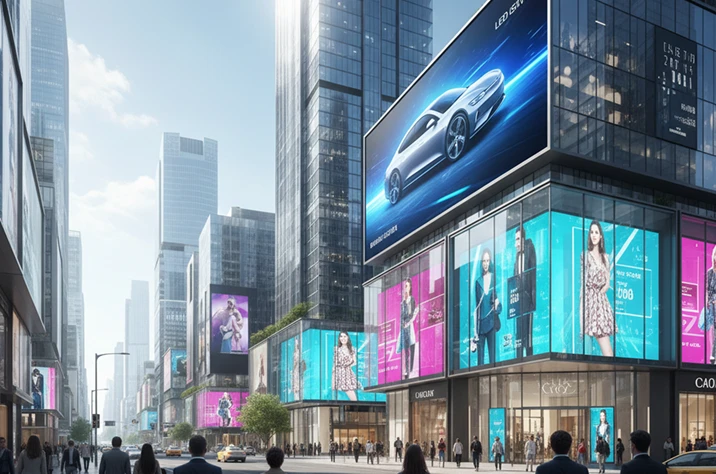
The landscape of out-of-home (OOH) advertising has been revolutionized by LED technology. Modern digital screens offer far more than simple static displays; they provide immersive, architecturally integrated, and highly flexible advertising solutions.
Here is a comprehensive breakdown of the different types of digital LED screens, categorized by their primary application and unique physical form.
I. Form Factors: Categorized by Application and Design
These categories define where the screen is used and its physical structure.
1. Outdoor Fixed Displays (Digital Billboards)
- Description: These are the traditional, large-format screens mounted on structures, buildings, or highways. They are the workhorses of OOH advertising.
- Key Features:
- High Brightness (Nits): Must exceed 5,000 nits to remain visible under direct sunlight.
- Durability (IP Rating): Require an IP65 (Ingress Protection) rating or higher to be completely sealed against rain, dust, and extreme temperatures.
- Technology: Historically used DIP (Dual In-line Package) for maximum brightness, but are now increasingly shifting to high-brightness SMD (Surface Mounted Device).
- Best For: Long-distance viewing, mass-market reach, and high-speed traffic routes.
2. Indoor Fine-Pitch Displays (Seamless Video Walls)
- Description: Designed for close-range viewing in commercial environments, these screens have virtually replaced traditional LCD video walls.
- Key Features:
- Fine Pixel Pitch (P1.2 – P2.5): The incredibly small gap between pixels ensures a high-definition image even when viewers are standing just a few feet away.
- No Bezels: Modules connect seamlessly, creating one continuous image without the distracting black lines found in LCD walls.
- Technology: Almost exclusively use SMD or the emerging COB (Chip on Board) technology for superior pixel protection and color uniformity.
- Best For: Retail stores, corporate lobbies, airports, and exhibition booths.
3. Transparent and Mesh LED Displays (Architectural Integration)
These two types allow light and air to pass through, but serve different purposes:
| Feature | Transparent LED | Mesh LED (Media Facade) |
| Structure | High-density LED strips mounted on a clear frame. | Low-density grid or net-like structure. |
| Transparency | High (60% to 95%). | Moderate (20% to 70%). |
| Best Used For | Storefront windows, glass curtain walls. | Massive building exteriors where weight and wind load are concerns. |
| Core Advantage | Maintains the view from inside and lets light in. | Allows air/wind to pass through, reducing building stress on huge installs. |
4. Creative and Flexible Displays
- Description: These screens utilize soft, rubber-based PCB modules instead of rigid cabinets, allowing the screen to conform to non-standard surfaces.
- Key Features: High level of design freedom. They can be installed on curved walls, wrapped around pillars, or formed into unique shapes (e.g., spheres or waves).
- Best For: Artistic installations, retail displays, and covering architectural columns.
5. 3D Anamorphic Displays
- Description: A high-impact trend that creates a “naked-eye” 3D illusion without special glasses.
- Key Features: This typically involves installing two high-resolution screens at a perfect 90-degree corner. The content is digitally mapped and distorted to create a perspective trick that makes objects appear to pop out of the corner and into the viewer’s space.
- Best For: Landmark advertising, brand activations, and achieving viral social media attention.
II. Technology Underpinnings: Understanding the Pixel
The choice of LED packaging technology dictates the screen’s resolution, durability, and cost.
| Technology | Full Name | Key Characteristic | Ideal Application |
| SMD | Surface Mounted Device | Three colors (R, G, B) in one protective package. The Current Standard. | Most indoor and outdoor screens. Offers the best balance of resolution and brightness. |
| COB | Chip on Board | Bare LED chips are glued directly onto the circuit board and covered in a robust epoxy resin. | Ultra-fine pitch (P0.9 or smaller) and high-touch areas. Offers maximum protection against dust, moisture, and impact. |
| GOB | Glue on Board | Standard SMD modules that have been coated with a protective glue layer. | Rental/staging screens for events and applications requiring added impact resistance without the cost of COB. |
Post you may like
 The Age of Digital Marketing: Transforming How Businesses ConnectDecember 1, 2025
 DOOH: The Evolution of Advertising in the Public SphereDecember 1, 2025
 The New Era of LED AdvertisingDecember 1, 2025
 Beyond the Billboard: Technologies Rewriting the DNA of AdvertisingDecember 1, 2025
 How LED Screens Can Revolutionize Business AdvertisingDecember 1, 2025